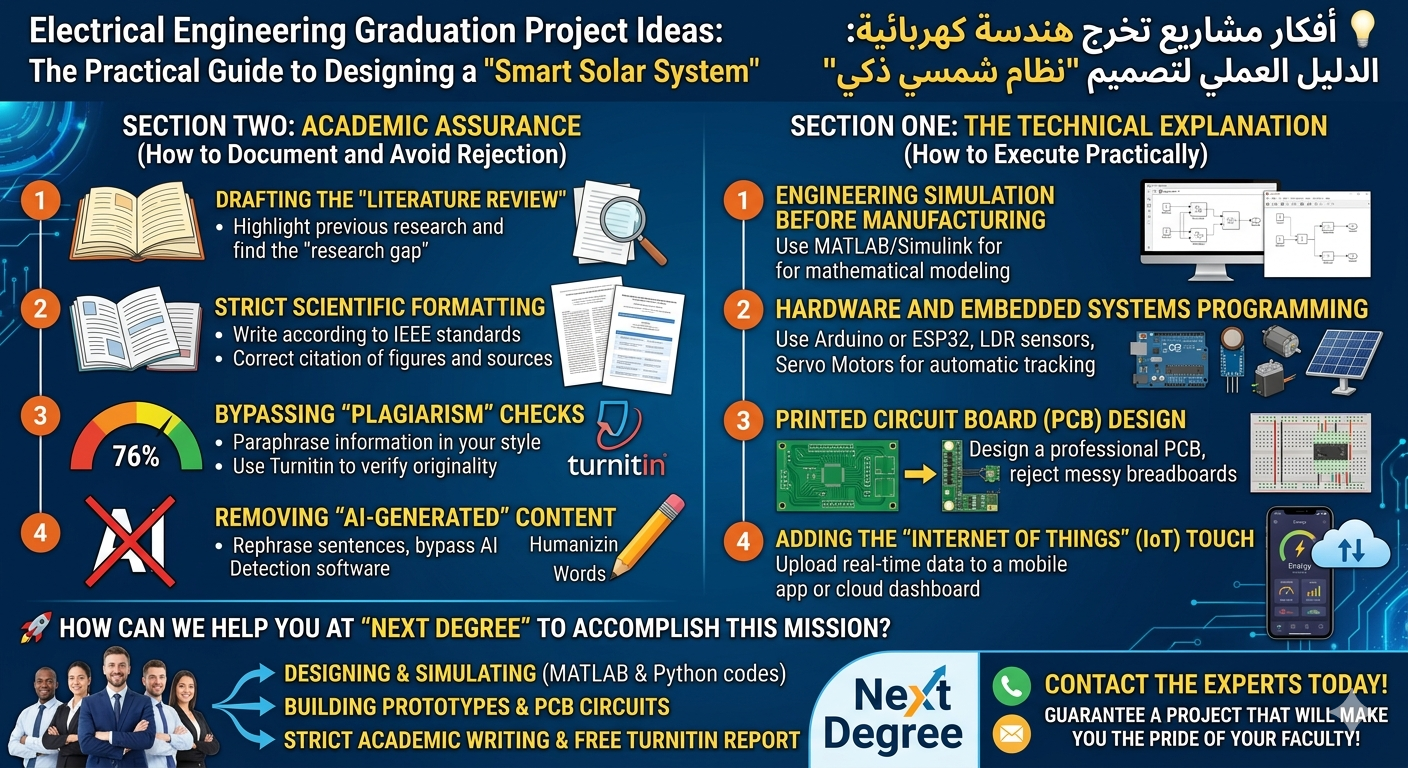
💡 "Electrical Engineering Graduation Project" Ideas: The Practical Guide to Designing a "Smart Solar System"
Many senior students search for "engineering graduation project ideas" that guarantee distinction. However, the biggest mistake most students make is choosing a flashy idea without knowing the technical tools to implement it or how to write about it academically.
If you are looking for an idea that combines hardware, software, and sustainability, designing an IoT-connected "Smart Solar Tracking System" is your perfect choice. In this guide from the experts at Next Degree, we won't just pitch the idea; we will explain technically and academically how to execute it from scratch until the defense day.
⚙️ First: The Technical Explanation (How to execute the project programmatically and practically?)
Traditional student services offices might give you the idea, but real engineering execution requires integrating "simulation software" with building "prototypes." To execute this project professionally, you need to pass through these technical milestones:
- Engineering Simulation Before Manufacturing: Do not start buying components immediately. You must use "MATLAB", specifically the "Simulink" environment, to build a mathematical model simulating the sun's movement and its impact on the panels. This proves to the committee that you are an "engineer" basing your decisions on precise calculations, not just an amateur.
- Hardware and Embedded Systems Programming: For the solar panel to automatically track the strongest light, you will need to use a microcontroller like "Arduino" or "ESP32", connected to light sensors (LDR) and "Servo Motors".
- Printed Circuit Board (PCB) Design: Connecting random wires on a "Breadboard" is unacceptable in the final defense. You must design and manufacture a professional "PCB" to ensure project stability and prevent circuits from burning during the presentation.
- Adding the "Internet of Things" (IoT) Touch: To get the highest grade, program the system to upload electricity production data instantly to a mobile app or a cloud "Dashboard", making your project aligned with the "Fourth Industrial Revolution."
📚 Second: Academic Assurance (How to document your project and avoid rejection?)
An impressive practical implementation can be in vain if the "Final Report" is written randomly. In engineering, documentation is just as important as manufacturing. Here is how to ensure the academic aspect:
- Drafting the "Literature Review": Judging committees look for "added value." Your report must highlight previous research in solar energy and the "research gap" your project addresses (such as reducing costs or increasing tracking efficiency).
- Strict Scientific Formatting: The project must be written according to global standards like "IEEE" formatting, with a focus on correct "Citation" for figures, equations, and source codes.
- Bypassing "Plagiarism" Checks: Copying and pasting from the internet is the fastest route to failing the project. You must paraphrase engineering information in your own style and subject the report to "Turnitin" to ensure the similarity percentage is within university limits.
- Removing "AI-Generated" Content: If you used AI tools to assist in writing, human intervention is required to rephrase sentences to bypass the "AI Detection" software currently used by universities.
🚀 How Can We Help You at "Next Degree" to Accomplish This Mission?
We know that mastering "technical solutions" and writing "academic research" at the same time is a massive challenge. Therefore, at the Next Degree platform, we bring together the expertise of a "field engineer" and the precision of an "academic professor" in one place.
Our team is ready to provide "comprehensive graduation project support" including:
- Designing and simulating complex codes on "MATLAB" and "Python".
- Building "prototypes" and manufacturing "PCB" circuits professionally.
- Strict academic writing, providing a free "Turnitin" report to prove the originality of your project.
📞 Don't waste your time between offices that don't understand technology, and engineers who haven't mastered academic documentation. Contact the "Next Degree" experts today, and guarantee a project that will make you the pride of your faculty!
Need to apply this methodology to your project?
Share your goal and current stage, and we will suggest the most useful next step.