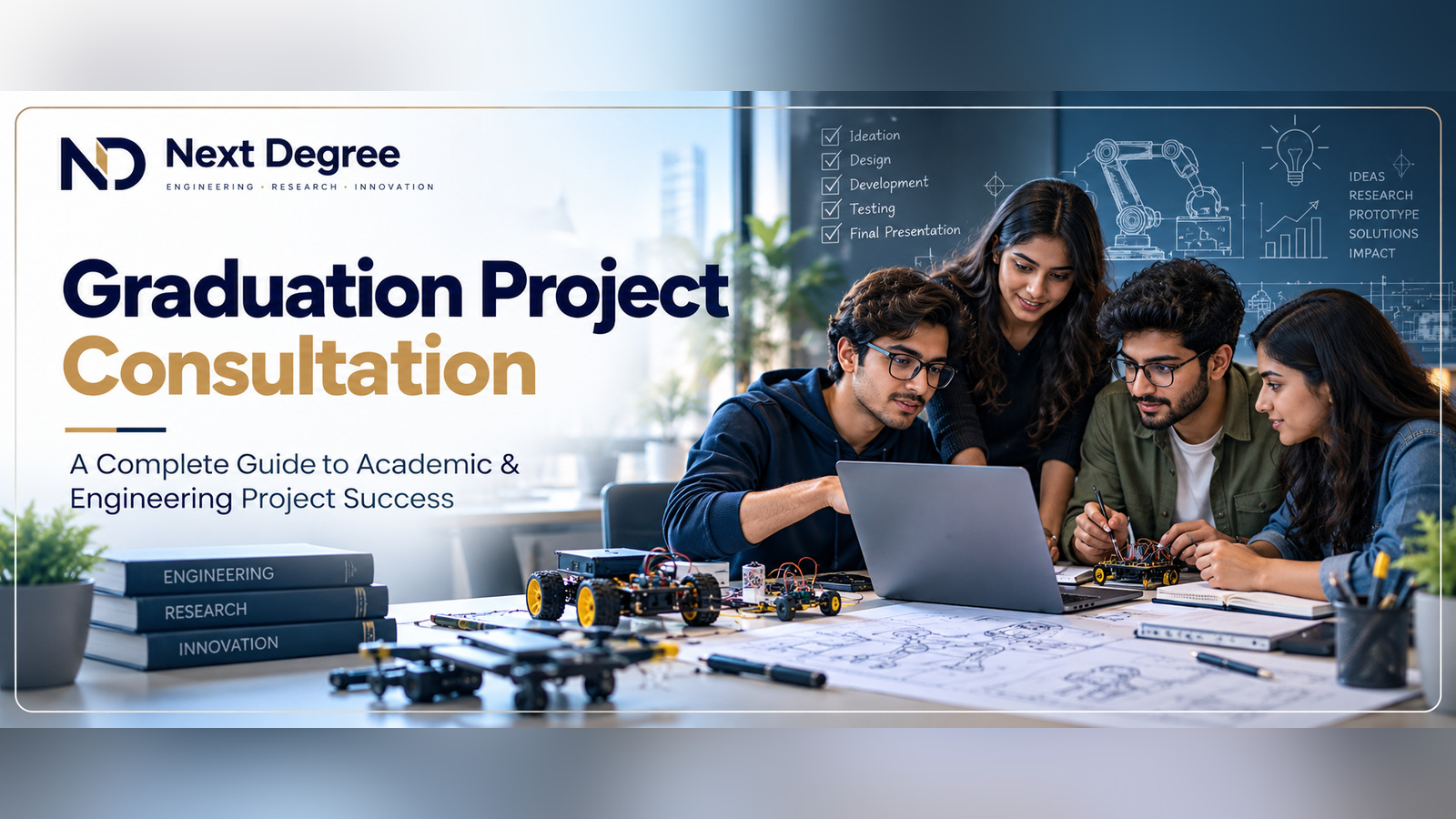
Graduation Project Consultation : Your Complete Guide to Academic and Engineering Project Success
Your graduation project is more than just another university assignment. It represents years of learning, practical experience, and your ability to transform academic knowledge into meaningful results.
For many students, however, turning a promising idea into a successful final-year project can feel overwhelming. Between selecting a research topic, understanding technical requirements, managing deadlines, and preparing for the final presentation, challenges can quickly accumulate.
This is where graduation project consultation makes a difference.
With appropriate academic guidance and technical mentorship, students can approach complex projects with greater confidence, develop stronger problem-solving skills, and produce work they genuinely understand.
In this guide, we explore what graduation project consultation involves, why it matters, and how students can benefit from professional support throughout their academic journey.
What Is Graduation Project Consultation?
Graduation project consultation is a structured academic support service designed to guide students through the planning, development, evaluation, and presentation of their final-year university projects.
Rather than simply providing ready-made solutions, effective consultation focuses on helping students understand the requirements of their projects and make informed academic and technical decisions.
A professional graduation project consultant may assist with:
Selecting and evaluating suitable project ideas.
Defining research objectives and technical requirements.
Developing a clear methodology and implementation plan.
Reviewing engineering designs, software architectures, or research models.
Troubleshooting technical challenges.
Evaluating testing procedures and project results.
Improving academic documentation and presentation skills.
The primary objective is to support independent learning while ensuring that students maintain ownership of their academic work.
For engineering students, this guidance is especially valuable because graduation projects often combine theoretical knowledge with software development, hardware integration, simulations, and experimental testing.
Why Do Students Need Graduation Project Consultation?
Even academically strong students sometimes struggle with graduation projects.
Unlike traditional coursework, a final-year project requires independent research, planning, technical implementation, and continuous decision-making.
Here are some common challenges.
1. Difficulty Choosing the Right Project Idea
Selecting a graduation project topic is often the first major obstacle.
Students may have several interesting ideas but struggle to determine which ones are technically achievable within the available time and budget.
Professional consultation helps evaluate potential topics according to academic relevance, available resources, technical complexity, and expected outcomes.
A well-selected topic provides a strong foundation for the entire project.
2. Limited Technical Experience
Some graduation projects require practical experience with technologies that students have only studied theoretically.
For example, an engineering project might involve MATLAB simulations, Python programming, embedded systems, Arduino, Raspberry Pi, or Internet of Things (IoT) applications.
Technical mentorship can help students understand these tools, identify suitable learning resources, and apply engineering concepts more effectively.
3. Poor Time Management
Graduation projects usually involve multiple stages, including research, design, implementation, testing, and documentation.
Without proper planning, students may spend too much time on early research and leave insufficient time for practical implementation.
A structured consultation process helps establish realistic milestones and monitor progress.
4. Challenges in Academic Writing
A functional prototype alone may not satisfy university assessment requirements.
Students must often explain their methodology, present results, discuss limitations, and support their conclusions with credible academic references.
Consultation can improve technical writing, report organization, referencing practices, and the clarity of research arguments.
How Graduation Project Consultation Works: Step by Step
A successful consultation process follows a clear structure that supports students from their initial ideas to their final academic defense.
Step 1: Project Idea Selection and Feasibility Assessment
The first stage involves understanding the student's academic specialization, interests, university requirements, and available resources.
Consultants can help students compare different project ideas and identify suitable research questions.
For example, an electrical engineering student interested in renewable energy might explore a solar tracking system, energy monitoring platform, or smart power management solution.
Each concept should be assessed for feasibility before implementation begins.
Step 2: Defining Objectives and Research Methodology
Once the topic is selected, students need clear and measurable objectives.
A strong project proposal should explain the problem being addressed, why it matters, and how the proposed solution will be evaluated.
Consultation helps students establish appropriate research methods, technical specifications, expected deliverables, and performance indicators.
This stage reduces uncertainty and provides a roadmap for the project.
Step 3: Engineering Design and Technical Planning
For technical graduation projects, proper system design is essential.
Depending on the discipline, this stage may involve developing system architecture diagrams, selecting hardware components, reviewing algorithms, or planning simulation models.
Engineering consultation helps students evaluate design alternatives and understand the strengths and limitations of different approaches.
Good design decisions early in the process can prevent expensive or time-consuming changes later.
Step 4: Implementation and Technical Troubleshooting
Implementation is where theoretical concepts become practical applications.
Students may encounter programming errors, hardware compatibility problems, unexpected simulation results, or integration difficulties.
A technical mentor can guide students through systematic debugging, explain underlying engineering principles, and recommend suitable testing strategies.
The goal is not to replace the student's work but to help them develop the skills needed to solve problems independently.
Step 5: Testing, Validation, and Performance Evaluation
A successful graduation project should demonstrate that its proposed solution works as intended.
Testing may include software verification, experimental measurements, simulation comparisons, prototype evaluation, or performance benchmarking.
Consultation helps students select meaningful evaluation metrics and interpret their results accurately.
For instance, an IoT monitoring project could be evaluated according to sensor accuracy, communication reliability, response time, and power consumption.
Documenting these measurements strengthens the technical credibility of the project.
Step 6: Documentation and Final Defense Preparation
The final stage involves presenting the completed work clearly and professionally.
Students should be able to explain their objectives, methodology, implementation decisions, results, limitations, and possible future improvements.
Graduation project consultation can support report review, slide organization, technical demonstrations, and mock defense sessions.
Practicing potential examination questions also helps students become more confident when discussing their decisions with academic supervisors.
Graduation Project Consultation for Different Engineering Specializations
Engineering graduation projects vary significantly according to academic discipline.
Specialized consultation helps students address technical challenges relevant to their fields.
Electrical and Electronics Engineering: Students may require guidance in circuit design, control systems, power electronics, renewable energy, or embedded programming.
Computer and Software Engineering: Common project areas include web applications, mobile applications, artificial intelligence, machine learning, cybersecurity, and software architecture.
Mechatronics and Robotics: Projects frequently involve sensors, actuators, robotics platforms, control algorithms, and hardware-software integration.
Mechanical Engineering: Consultation may focus on CAD modeling, mechanical design, thermal analysis, fluid dynamics, and engineering simulations.
Civil Engineering: Students may need support understanding structural analysis, construction management, sustainable materials, or engineering modeling.
Regardless of specialization, the most valuable consultation combines subject knowledge with clear methodology and practical evaluation.
How to Choose the Right Graduation Project Consultant
Choosing an appropriate consultant is an important academic decision.
Before committing to a service, students should evaluate several factors.
Relevant technical expertise: The consultant should understand the technologies, research methods, and engineering principles relevant to the project.
Clear communication: Complex technical explanations should be presented in an understandable and supportive manner.
Structured milestones: A professional consultation process should establish clear objectives, review sessions, and expected outcomes.
Academic integrity: Students should remain responsible for original academic contributions, experiments, implementation, and submitted work.
Documentation and feedback: Constructive feedback should help students understand their progress and improve their skills.
A reliable consultant should encourage questions and independent thinking rather than offer unrealistic guarantees of academic grades or project approval.
Common Mistakes to Avoid During Your Graduation Project
Many graduation project difficulties are preventable with proper preparation.
One common mistake is selecting an overly ambitious topic without considering technical feasibility. Students sometimes choose advanced technologies simply because they appear impressive, even when a simpler solution would demonstrate stronger engineering understanding.
Another problem is delaying practical implementation until the final weeks of the semester.
Students should also avoid overlooking testing and documentation. A project that works during one demonstration may still require systematic evidence to establish reliability.
Finally, depending entirely on external assistance can undermine both learning and academic integrity.
The best graduation projects reflect genuine student participation, thoughtful decisions, and a clear understanding of the final results.
Why Choose Next Degree for Graduation Project Consultation?
At Next Degree, we understand that every graduation project represents a different academic journey.
Our approach emphasizes structured engineering guidance, practical technical support, and research-based problem-solving.
We help students move from initial project ideas toward clear methodologies, measurable results, and confident final presentations.
Our areas of support include:
Graduation project idea development and feasibility reviews.
Engineering research methodology and project planning.
MATLAB, Simulink, and Python analysis guidance.
Embedded systems, IoT, and electronics prototyping.
Technical design reviews and implementation guidance.
Project testing, documentation, and presentation preparation.
We work with engineering students across Egypt and the wider MENA region, offering consultation tailored to each project's academic requirements and technical challenges.
Most importantly, our consultation approach supports students' academic responsibility and understanding rather than replacing their original work.
Frequently Asked Questions About Graduation Project Consultation
When should I seek graduation project consultation?
Ideally, consultation should begin during the topic selection or proposal stage. However, students can also benefit from targeted technical guidance during implementation, testing, or final defense preparation.
Can graduation project consultation help with engineering projects?
Yes. Specialized consultation can support engineering design, simulation methodology, programming concepts, hardware integration, testing strategies, and technical documentation.
Is graduation project consultation suitable for group projects?
Yes. Teams can benefit from guidance on project scope, task allocation, technical coordination, milestone planning, and consistent documentation.
Is graduation project consultation academically acceptable?
Consultation is generally appropriate when it follows university rules and focuses on mentorship, feedback, and permitted technical assistance. Students must understand and complete their own required academic contributions.
Can I request consultation if my project has already started?
Yes. A consultant can review the current project stage, identify challenges, and recommend practical next steps without requiring the team to restart unnecessarily.
Final Thoughts: Build Your Graduation Project with Confidence
A successful graduation project is not necessarily the most complicated one. It is a project that addresses a clear problem, follows a sound methodology, demonstrates meaningful results, and reflects the student's understanding.
With the right graduation project consultation, challenges can become opportunities to strengthen your technical knowledge, research abilities, and professional confidence.
Whether you are choosing your first idea, developing an engineering prototype, or preparing for your final defense, structured guidance can help you make better decisions throughout the process.
Ready to take your graduation project to the next level?
Connect with Next Degree for professional graduation project consultation and discover how our engineering specialists can support your academic journey.
References used for this article
Questions related to this guide
What is graduation project consultation?
A structured academic guidance service that helps students plan, develop, evaluate, and present their final-year projects.
2. How can graduation project consultation help engineering students?
It provides technical mentorship in research planning, engineering design, simulation, troubleshooting, testing, and documentation.
How do I choose the right graduation project idea?
Compare ideas based on your interests, academic requirements, available resources, technical complexity, and project deadlines.
When should I start looking for graduation project consultation?
Ideally, during topic selection or proposal development, although targeted consultation can help at later stages.
Can I get graduation project consultation online?
Yes. Many aspects of consultation, such as design reviews, simulation guidance, and project planning, can be delivered remotely.
How much does graduation project consultation cost?
Pricing varies according to project complexity, specialization, consultation duration, and the type of technical support required.
What engineering specializations can benefit from consultation?
Electrical, electronics, computer, software, mechanical, mechatronics, robotics, and related engineering disciplines.
Can a consultant help with MATLAB, Simulink, or Python?
Technical consultation can help students understand modeling, programming, debugging, and appropriate testing methodologies.
How can I prepare for my graduation project defense?
Review your objectives, methodology, results, limitations, and technical decisions. Practice explaining your work and answering questions.
Is graduation project consultation academically acceptable?
It can be, when it complies with university rules and supports learning, feedback, and student-owned academic work.
Need to apply this methodology to your project?
Share your goal and current stage, and we will suggest the most useful next step.