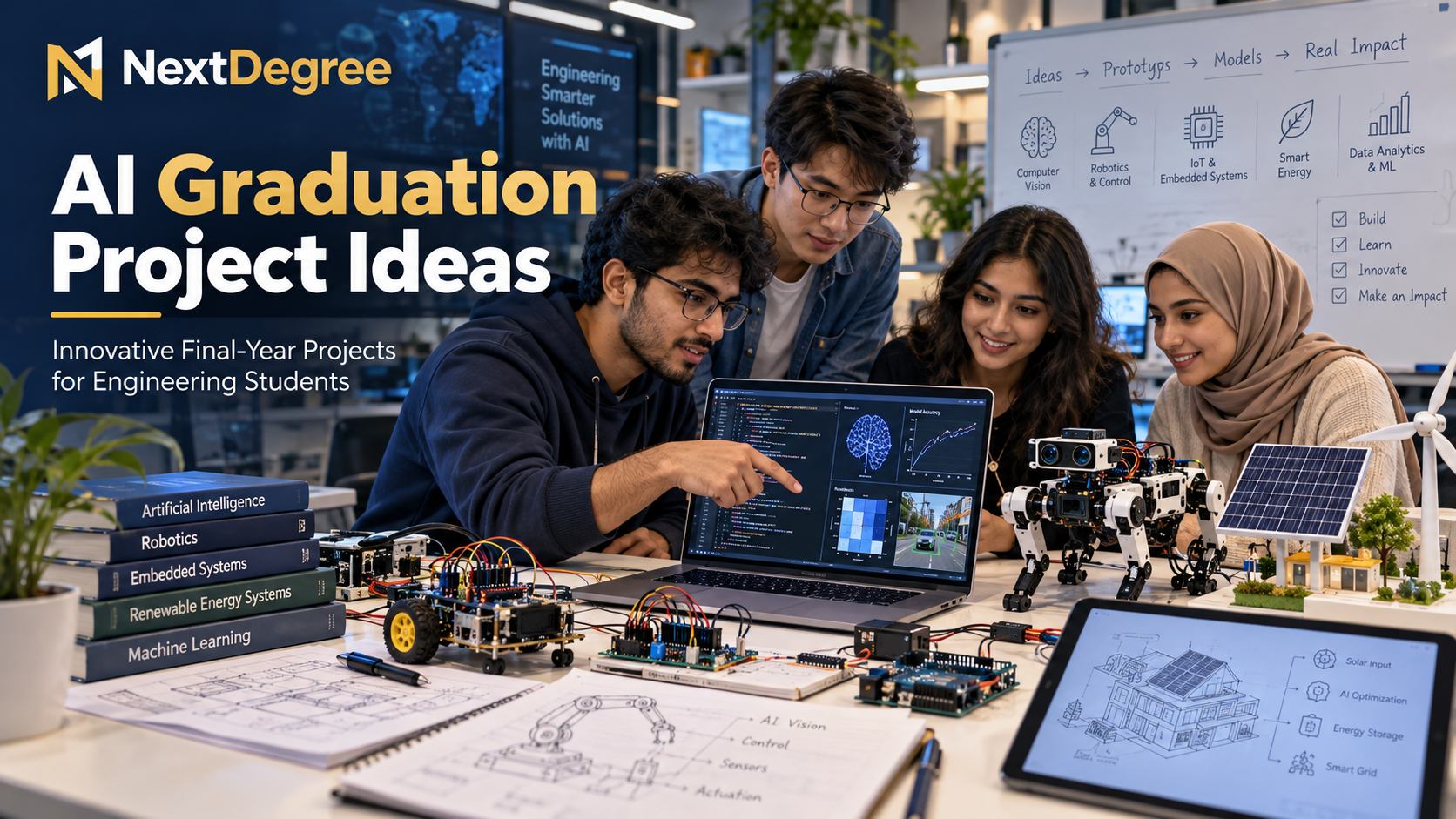
Find an AI project that fits your discipline
Compare project ideas by difficulty and hardware availability.
Artificial intelligence offers engineering students an opportunity to develop practical graduation projects that address real-world challenges using machine learning, computer vision, robotics, embedded systems and the Internet of Things (IoT).
The best AI graduation project is not necessarily the most complicated one. It is a project with a clearly defined problem, accessible data, a feasible implementation plan and measurable performance.
This guide presents 20 artificial intelligence graduation project ideas for 2027, including recommended technologies, difficulty levels and evaluation metrics.
Top 20 AI Graduation Project Ideas for Engineering Students
| Project idea | Recommended technologies | Difficulty | Evaluation metrics |
|---|---|---|---|
| Arabic sign language recognition | Python, MediaPipe, Raspberry Pi | Intermediate | F1-score, latency |
| Intelligent traffic monitoring | OpenCV, object detection | Advanced | mAP, processing speed |
| Driver drowsiness detection | Computer vision, facial landmarks | Intermediate | Recall, false alarm rate |
| Smart healthcare monitoring prototype | ESP32, IoT, anomaly detection | Advanced | Sensor error, alert latency |
| AI-based waste classification | CNN, Raspberry Pi | Intermediate | F1-score, inference time |
| Predictive maintenance system | Python, vibration sensors | Advanced | Precision, recall |
| Plant disease detection | CNN, transfer learning | Intermediate | Macro F1-score |
| Solar energy forecasting | Python, MATLAB | Intermediate | MAE, RMSE |
| Smart energy management | ESP32, IoT, forecasting | Advanced | Energy consumption |
| Autonomous mobile robot | ROS 2, computer vision | Advanced | Navigation success rate |
| Medical image segmentation | U-Net, PyTorch | Advanced | Dice score, IoU |
| Air quality prediction | ESP32, machine learning | Intermediate | MAE, RMSE |
| Network anomaly detection | Python, scikit-learn | Intermediate | F1-score, false positive rate |
| Intelligent irrigation system | IoT, soil sensors, ML | Intermediate | Water consumption |
| Industrial visual inspection | OpenCV, deep learning | Advanced | Defect recall, precision |
| Arabic document recognition | OCR, natural language processing | Advanced | Character error rate |
| Smart parking system | Computer vision, ESP32 | Intermediate | Occupancy detection accuracy |
| AI-powered educational assistant | NLP, retrieval-augmented generation | Intermediate | Answer accuracy, source grounding |
| Structural crack detection | CNN, image segmentation | Advanced | Precision, IoU |
| Edge AI environmental monitoring | ESP32-S3, TinyML | Advanced | Latency, power consumption |
Difficulty levels are indicative and depend on project scope, team experience and available resources.
Best AI Graduation Projects by Engineering Discipline
Computer and Software Engineering
Computer engineering students can develop Arabic document recognition, intelligent educational assistants, computer vision applications and network anomaly detection systems.
These projects offer opportunities to combine software engineering, machine learning, database management and application development.
Electrical and Electronics Engineering
Suitable projects include predictive maintenance, solar energy forecasting, smart energy management and intelligent sensor systems.
Students can integrate MATLAB, Python, microcontrollers and signal-processing algorithms to develop measurable engineering solutions.
Mechatronics and Robotics Engineering
Mechatronics students can explore autonomous navigation, intelligent robotic systems, visual inspection and AI-enabled control systems.
These projects combine mechanical design, electronic circuits, embedded programming and intelligent decision-making.
Biomedical Engineering
Potential research prototypes include medical image segmentation, physiological signal analysis and anomaly detection in sensor measurements.
Medical AI projects must be treated as educational research prototypes unless they have undergone the necessary clinical validation and regulatory approval. They must not be presented as clinically validated diagnostic devices.
How to Choose the Right AI Graduation Project
Before selecting a project, evaluate these six criteria:
Problem relevance: Does the project address a meaningful engineering problem?
Data availability: Can you access sufficient, appropriately licensed and representative data?
Technical feasibility: Do you have the necessary hardware, software and computing resources?
Evaluation strategy: Can you measure the performance objectively?
Budget: Can your team afford components, manufacturing and testing?
Timeline: Can the project be implemented and validated before the final defense?
If you are unsure which project suits your department, experience and budget, explore Next Degree's engineering graduation project mentorship.
AI Graduation Project Hardware Requirements
| Component | Typical application |
|---|---|
| ESP32 | IoT, sensing and lightweight embedded applications |
| ESP32-S3 | Selected resource-constrained machine learning applications |
| Raspberry Pi | Computer vision and edge computing prototypes |
| Arduino | Sensor integration and basic control |
| Camera module | Image processing and visual recognition |
| Environmental sensors | Monitoring and predictive systems |
| Motor drivers and actuators | Robotics and automation |
| Computer or GPU environment | Model training and evaluation |
Not every project requires expensive hardware. Software-based prototypes may be developed using existing computers and public datasets.
Learn more about Arduino, ESP32 and Raspberry Pi engineering consultation.
Recommended Artificial Intelligence Development Tools
Python: General-purpose AI and scientific programming.
OpenCV: Computer vision and image processing.
scikit-learn: Classical machine learning and model evaluation.
PyTorch: Deep learning development.
TensorFlow: Machine learning and neural networks.
MATLAB: Engineering analysis, modeling and numerical computation.
ESP-IDF: Embedded development for ESP32 devices.
How to Evaluate an AI Graduation Project
A professional engineering project should provide evidence that its solution works under clearly defined testing conditions.
| Metric | Purpose |
|---|---|
| Accuracy | Overall classification correctness |
| Precision | Proportion of positive predictions that are correct |
| Recall | Proportion of actual positive cases successfully detected |
| F1-score | Balance between precision and recall |
| MAE | Average absolute prediction error |
| RMSE | Prediction error with greater sensitivity to large errors |
| IoU | Overlap between predicted and reference regions |
| Dice score | Segmentation agreement |
| Inference latency | Time required to generate a prediction |
| Power consumption | Energy efficiency of hardware implementation |
Avoid relying exclusively on accuracy, particularly when datasets contain imbalanced classes.
Refer to the official scikit-learn model evaluation documentation for detailed evaluation methods.
How Much Does an AI Graduation Project Cost?
The cost depends on whether the project requires software development, specialized hardware, sensors, cloud computing or mechanical manufacturing.
Prepare a budget that covers:
Hardware and electronic components.
Data collection and preparation.
Computing resources.
Prototype manufacturing.
Testing and replacement components.
Technical training or consultation when needed.
Prepare a bill of materials before purchasing equipment. A simple, well-validated prototype may deliver more academic value than an expensive system with insufficient testing.
Suggested 12-Week Implementation Roadmap
| Period | Engineering activities |
|---|---|
| Weeks 1–2 | Problem definition, literature review and project selection |
| Weeks 3–4 | System architecture and data preparation |
| Weeks 5–6 | Baseline model and initial prototype |
| Weeks 7–8 | Model improvement and system integration |
| Weeks 9–10 | Experimental testing and evaluation |
| Week 11 | Technical documentation and limitations |
| Week 12 | Demonstration and defense preparation |
The timeline is illustrative and should be adapted to university requirements and project complexity.
Explore the engineering graduation project roadmap for additional planning guidance.
How Next Degree Can Support Your AI Graduation Project
Next Degree provides specialized engineering mentorship and technical consultation for graduation project teams in Egypt and across the Middle East.
Our support can include:
Project feasibility assessment.
Architecture and component selection.
Dataset preparation guidance.
Machine learning model development guidance.
Embedded systems and IoT consultation.
Debugging and prototype testing.
Evaluation methodology and technical review.
Engineering presentation and defense preparation.
Explore our engineering services and engineering portfolio.
Students retain responsibility for their original academic work and must comply with their institution's academic integrity requirements.
Book Your Free AI Graduation Project Consultation
Not sure which artificial intelligence project is right for your team?
Share your engineering department, team size, budget, available hardware and submission deadline with Next Degree. Our initial consultation can help you identify a feasible technical direction and appropriate next steps.
Start your free engineering consultation
Next Degree — Engineering. Research. Innovation.
References used for this article
- Google for Developers — Machine Learning Crash Course | [
- Google for Developers — Managing Machine Learning Projects | [
- UCI Machine Learning Repository — Official Engineering and Machine Learning Datasets | [
- UCI Machine Learning Repository — AI4I 2020 Predictive Maintenance Dataset | [
- scikit-learn — Machine Learning Model Evaluation and Performance Metrics | [
- scikit-learn — Cross-Validation and Model Reliability | [
- TensorFlow — Official Machine Learning and Deep Learning Framework | [
- PyTorch — Deep Learning Research and Development Framework | [
- OpenCV — Computer Vision and Image Processing Library | [
- MathWorks — Deep Learning Toolbox for Engineering Applications | [
- Edge Impulse — Edge AI and Embedded Machine Learning Documentation | [
- Hugging Face — Datasets for Artificial Intelligence Research | [
- NIST — Artificial Intelligence Risk Management Framework | [
- NumPy — Scientific Computing with Python | [
- pandas — Python Data Analysis and Manipulation Library | [
Questions related to this guide
What are the best AI graduation project ideas for engineering students?
The best AI graduation project ideas for engineering students include predictive maintenance systems, AI-powered smart irrigation, solar energy forecasting, intelligent traffic monitoring, autonomous robotics, machine learning-based cybersecurity, computer vision defect detection, and AI-assisted wireless communication systems. The ideal choice depends on the student's specialization, technical skills, available datasets, and project resources.
Which AI graduation projects are best for beginners?
Beginner-friendly AI graduation projects include image classification, smart irrigation monitoring, solar power forecasting, hand gesture recognition, and basic anomaly detection. These projects introduce essential machine learning concepts while allowing students to develop practical prototypes using Python, scikit-learn, and accessible datasets.
What are the best AI projects for electrical engineering students?
Electrical engineering students can develop AI-based solar energy forecasting systems, smart grid load prediction models, electric motor fault diagnosis systems, battery health estimation applications, and intelligent energy management solutions. These projects combine machine learning with electrical engineering analysis, simulation, and practical applications.
What AI graduation projects are suitable for communication engineering students?
Suitable AI graduation projects for communication engineering students include automatic modulation classification, intelligent beam selection for 5G networks, wireless traffic prediction, AI-based spectrum analysis, IoT anomaly detection, and machine learning-based network intrusion detection. These topics combine artificial intelligence with signal processing and wireless communication systems.
Can I complete an AI graduation project using Python?
Yes. Python is widely used for AI graduation projects because it supports data analysis, machine learning, deep learning, computer vision, and scientific computing. Popular libraries include NumPy, pandas, scikit-learn, TensorFlow, PyTorch, and OpenCV. Many AI projects can be completed entirely in Python without specialized hardware.
Can ESP32 be used for artificial intelligence graduation projects?
Yes. ESP32 microcontrollers can be used in AI-enabled IoT graduation projects, including smart irrigation, environmental monitoring, sensor-based anomaly detection, and intelligent energy monitoring. An ESP32 can collect sensor measurements and communicate with an external AI service, while suitable lightweight machine learning models may run directly on supported microcontroller hardware.
What are the best AI graduation projects without hardware?
Students can develop AI projects without physical hardware using publicly available datasets, simulation tools, and software frameworks. Examples include solar energy forecasting, predictive maintenance classification, network intrusion detection, concrete crack recognition, automatic modulation classification, and AI-powered academic research assistants.
How do I choose an innovative AI graduation project?
To select an innovative AI graduation project, identify a practical engineering problem, review existing research, evaluate available datasets, and define a measurable technical objective. Innovation can involve improving model accuracy, reducing computational complexity, increasing reliability, developing an efficient embedded implementation, or testing models under new engineering conditions.
Which is better for AI graduation projects: MATLAB or Python?
Both MATLAB and Python are suitable for artificial intelligence graduation projects. Python provides an extensive open-source ecosystem for machine learning and deep learning, while MATLAB offers strong integration with engineering simulation, control systems, and signal processing workflows. The best choice depends on project requirements, software access, and the student's experience.
How long does it take to complete an AI graduation project?
A focused AI graduation project may be completed within a university semester, depending on its complexity and the team's technical experience. A typical development process includes topic selection, literature review, dataset preparation, model training, performance evaluation, prototype development, documentation, and final presentation. Hardware-intensive projects may require additional time.
What datasets can engineering students use for AI graduation projects?
Engineering students can obtain datasets from the UCI Machine Learning Repository, Hugging Face Datasets, PhysioNet, and other authorized academic or institutional sources. Dataset selection should consider relevance to the engineering problem, data quality, licensing, representativeness, and the availability of suitable training and evaluation samples.
How can I evaluate the performance of an AI graduation project?
The evaluation method depends on the project objective. Classification systems commonly use precision, recall, F1-score, and confusion matrices. Prediction systems may use mean absolute error (MAE) and root mean square error (RMSE). Embedded AI projects should also evaluate processing latency, memory consumption, energy efficiency, and operational reliability.
Can an AI graduation project be published in a scientific journal?
Yes. An AI graduation project may form the basis of a scientific publication if it demonstrates an original contribution, a sound research methodology, reproducible experiments, and convincing evaluation results. Publication is not guaranteed and depends on the quality, novelty, relevance, and scientific rigor of the research.
What are the most important skills required for an AI graduation project?
Important skills include programming, mathematics, statistics, data preprocessing, machine learning fundamentals, engineering problem-solving, model evaluation, technical documentation, and scientific research. Hardware-based projects may additionally require knowledge of sensors, microcontrollers, communication protocols, and embedded systems.
How can I make my AI graduation project stand out during the final defense?
An outstanding AI graduation project should demonstrate a clearly defined engineering problem, a justified methodology, a working implementation, and measurable experimental results. Students should explain their system architecture, compare the proposed method against a baseline, present meaningful performance metrics, discuss limitations, and demonstrate a prototype whenever possible.
Need to apply this methodology to your project?
Share your goal and current stage, and we will suggest the most useful next step.