25 Communication Engineering Graduation Project Ideas for 2026
From 5G and 6G wireless networks to artificial intelligence, IoT, antenna design, and advanced communication systems
Communication engineering is evolving rapidly. The convergence of artificial intelligence (AI), fifth-generation mobile networks (5G), emerging sixth-generation technologies (6G), the Internet of Things (IoT), and intelligent wireless systems is creating exciting opportunities for engineering students.
For final-year telecommunications and electronics engineering students, selecting the right graduation project is an important step toward developing technical expertise, gaining practical experience, and preparing for research or industry careers.
A successful communication engineering graduation project should demonstrate more than a working prototype. It should identify a technical problem, apply appropriate engineering methods, evaluate measurable performance, and explain how the proposed solution compares with existing approaches.
This guide from NextDegree presents 25 communication engineering graduation project ideas for 2026, including achievable implementations, recommended software, technical objectives, and possible research contributions.
Quick Answer: What Are the Best Communication Engineering Graduation Projects for 2026?

The best communication engineering graduation projects for 2026 include AI-assisted 5G beamforming, Massive MIMO detection, 5G network simulation, intelligent handover optimization, 6G integrated sensing and communication, software-defined radio, IoT sensor networks, intelligent antenna systems, satellite communication, and machine-learning-based network security.
Students should choose a project according to their knowledge of digital communications, available hardware, programming skills, budget, and time.
For research-oriented students, AI-assisted wireless systems and emerging 6G technologies offer valuable opportunities. For students seeking practical hardware experience, LoRaWAN, SDR, antenna design, and wireless sensor networks are suitable starting points.
Key Takeaways
5G and 6G research: Projects involving beamforming, Massive MIMO, intelligent radio resource management, and integrated sensing offer strong research potential.
AI in telecommunications: Machine learning can support channel estimation, anomaly detection, network optimization, and energy management.
IoT and wireless systems: LoRaWAN, wireless sensors, and positioning systems provide opportunities to develop working prototypes.
MATLAB and Python: Both are useful for wireless communication modeling, digital signal processing, and performance evaluation.
Hardware is not always necessary: Simulation-based projects can demonstrate meaningful engineering contributions when supported by rigorous experiments.
Originality matters: A graduation project becomes stronger when it includes a validated improvement, useful dataset, reproducible benchmark, or carefully evaluated practical implementation.
Why Communication Engineering Graduation Projects Matter in 2026
Communication engineering supports many essential technologies, including mobile networks, satellite systems, wireless connectivity, smart infrastructure, connected vehicles, industrial automation, and digital services.
Several technical developments make 2026 particularly interesting for graduation projects.
1. Evolution of 5G-Advanced
5G-Advanced extends the capabilities of existing 5G networks through improvements in efficiency, intelligence, positioning, and network performance.
Potential student research areas include intelligent scheduling, adaptive beamforming, network energy efficiency, and machine-learning-assisted optimization.
2. Early 6G Research and Standardization
Sixth-generation mobile networks are still under development in 2026.
The International Telecommunication Union's IMT-2030 framework identifies future communication scenarios involving AI, integrated sensing, ubiquitous connectivity, and highly reliable communications.
Meanwhile, 3GPP Release 20 includes studies relevant to the transition toward 6G.
Students can investigate proposed 6G technologies through analytical modeling and simulation without claiming to implement a completed commercial 6G network.
3. Artificial Intelligence in Wireless Networks
AI and machine learning can help engineers analyze communication environments, estimate wireless channels, predict traffic conditions, and optimize network resources.
However, an effective AI project must compare its performance against conventional algorithms rather than assuming that machine learning automatically improves a system.
4. Expansion of Connected Devices
Smart agriculture, environmental monitoring, infrastructure monitoring, and industrial sensing increasingly depend on communication systems designed for reliability and low energy consumption.
These applications create practical graduation project opportunities using IoT development boards, wireless modules, and cloud or local monitoring systems.
25 Best Communication Engineering Graduation Project Ideas
The following projects are grouped into five areas:
5G, 6G, and intelligent wireless networks.
Digital signal processing, SDR, and antenna systems.
IoT and smart wireless applications.
Optical, satellite, and next-generation connectivity.
AI, network security, and sustainable communications.
Category 1: 5G, 6G, and Intelligent Wireless Networks
1. AI-Assisted Beamforming Optimization for 5G Networks
Difficulty: Advanced
Project concept
Beamforming is an important technique in modern wireless systems. It allows antenna arrays to direct transmitted or received signal energy spatially rather than treating all directions equally.
This project investigates whether machine learning can improve beam selection in changing wireless environments.
Project objectives
Model a multi-antenna wireless communication system.
Implement a conventional beam selection algorithm.
Develop an AI-based model for selecting suitable beams.
Compare signal quality, spectral efficiency, and processing complexity.
Recommended tools: MATLAB, Python, NumPy, PyTorch, and appropriate channel models.
Implementation methodology
Students can generate synthetic wireless channel data, develop an antenna array model, and train a supervised-learning model to predict beam choices.
The model should be evaluated using previously unseen channel realizations and compared with a conventional codebook-search method.
Expected deliverables: A beamforming simulator, trained model, channel visualization, and comparative performance report.
Research opportunity: Evaluate whether reduced beam-search overhead justifies the model's computational cost.
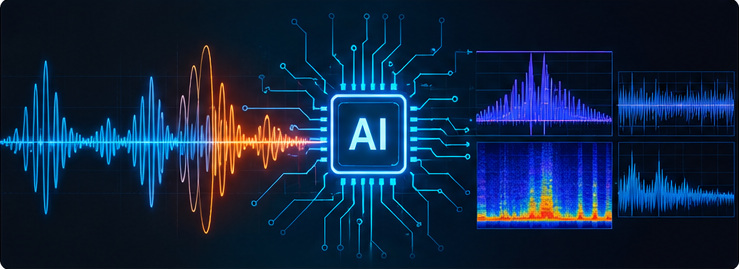
2. Massive MIMO Signal Detection Using Deep Learning
Difficulty: Advanced
Project concept
Massive Multiple-Input Multiple-Output (Massive MIMO) systems use multiple antennas to support improved wireless capacity and spatial multiplexing.
However, detecting transmitted symbols in large antenna systems can require substantial computation.
This project explores machine-learning-based signal detection.
Project objectives
Develop a MIMO transmission and reception model.
Implement conventional zero-forcing and minimum mean-square error detectors.
Train a neural-network-based detector.
Evaluate detection performance under different channel conditions.
Recommended tools: MATLAB, Python, TensorFlow or PyTorch.
Evaluation metrics: Bit error rate (BER), symbol error rate, runtime, and computational complexity.
Expected deliverables: A working MIMO simulator and comparative results.
Research opportunity: Investigate performance under imperfect channel estimation, where idealized detection assumptions may not hold.
3. Design and Simulation of a 5G NR Communication System
Difficulty: Intermediate to Advanced
Project concept
This project builds a simulation of key physical-layer components of a 5G New Radio communication link.
Students investigate how wireless channel conditions influence the performance of the system.
Project objectives
Generate digital data and map it to modulation symbols.
Implement orthogonal frequency-division multiplexing (OFDM).
Model wireless noise and multipath fading.
Perform channel estimation and equalization.
Recover the transmitted information.
Recommended tools: MATLAB 5G Toolbox or Python-based signal processing tools.
Evaluation metrics: BER, block error rate (when coding is included), error vector magnitude (EVM), and throughput.
Expected deliverables: An end-to-end simulation, constellation diagrams, BER curves, and a technical report.
Research opportunity: Compare alternative channel-estimation approaches under different signal-to-noise ratios.
Important: A simplified OFDM simulator is not automatically a fully standards-compliant 5G NR implementation. Clearly document which 3GPP procedures are modeled.
4. Intelligent Handover Optimization in Mobile Networks
Difficulty: Advanced
Project concept
When mobile devices move between coverage areas, the network must determine whether and when a connection should be transferred to another cell.
Poorly configured handovers can cause unnecessary switching, interruptions, and degraded service quality.
This project investigates intelligent handover decision-making.
Project objectives
Simulate a mobile communication network.
Model users moving between cells.
Implement a conventional threshold-based handover algorithm.
Design an improved algorithm using machine learning or adaptive thresholds.
Compare performance under different mobility conditions.
Recommended tools: ns-3, 5G-LENA, MATLAB, or Python.
Evaluation metrics: Handover failures, ping-pong handovers, packet loss, interruption time, and throughput.
Expected deliverables: Mobility scenarios, algorithms, simulation results, and comparative analysis.
Research opportunity: Optimize handover decisions while balancing reliability against excessive network switching.
5. Open RAN Intelligent Network Optimization
Difficulty: Advanced
Project concept
Open Radio Access Network (Open RAN) architectures support more open and interoperable approaches to managing radio networks.
The O-RAN ALLIANCE describes RAN Intelligent Controller functions that support network management and optimization.
This project investigates an intelligent application for radio resource management.
Project objectives
Study the principal elements of an O-RAN architecture.
Develop a simulated radio-network environment.
Implement an intelligent resource allocation policy.
Compare the policy against conventional scheduling strategies.
Recommended tools: Python, network simulators, and an appropriate O-RAN test environment if available.
Evaluation metrics: Throughput, latency, fairness, resource utilization, and decision overhead.
Expected deliverables: A proof-of-concept optimization application and performance report.
Research opportunity: Examine the trade-off between improved network allocation and controller computational overhead.
A simplified simulation should be described as O-RAN-inspired unless it actually implements the required interfaces and controller functions.
6. Integrated Sensing and Communication for Future 6G Systems
Difficulty: Advanced / Research-Oriented
Project concept
Integrated Sensing and Communication (ISAC) explores the use of communication infrastructure and signals to support both wireless connectivity and environmental sensing.
ISAC is an important research direction within the IMT-2030 framework.
Project objectives
Model an OFDM-based communication waveform.
Simulate target reflections and wireless propagation.
Estimate target range or relative motion from reflected signals.
Analyze how sensing requirements affect data transmission.
Recommended tools: MATLAB, Python, NumPy, and SciPy.
Evaluation metrics: Range-estimation error, Doppler-estimation error, BER, and spectral efficiency.
Expected deliverables: A joint sensing-and-communication simulation and comparative evaluation.
Research opportunity: Investigate waveform parameter choices that balance sensing accuracy with communication performance.
Academic relevance: Suitable for students considering postgraduate research in emerging wireless technologies.
7. Satellite-Assisted 5G/6G Network Performance Simulation
Difficulty: Advanced
Project concept
Non-terrestrial networks (NTNs) investigate connectivity through satellites and other non-terrestrial platforms.
A student project can examine how satellite propagation affects communication performance and service availability.
Project objectives
Model a satellite-to-ground communication link.
Calculate path loss and propagation delay.
Investigate the effects of satellite elevation and mobility.
Compare selected terrestrial and satellite-assisted scenarios.
Recommended tools: MATLAB, Python, satellite geometry libraries, and link-budget modeling tools.
Evaluation metrics: Link margin, outage probability, propagation delay, and coverage availability.
Expected deliverables: A satellite communication model, coverage analysis, and link-budget report.
Research opportunity: Study how adaptive modulation or routing decisions respond to changing satellite visibility.
Category 2: Digital Signal Processing, SDR, and Antenna Systems
8. Reconfigurable Intelligent Surface for Wireless Coverage Enhancement
Difficulty: Advanced
Project concept
A Reconfigurable Intelligent Surface (RIS) is a proposed technology involving surfaces whose electromagnetic response can be adjusted to influence signal propagation.
This project simulates an RIS-assisted wireless environment.
Project objectives
Model a direct wireless communication channel.
Introduce a simplified RIS-assisted propagation path.
Optimize reflected signal phases.
Compare coverage and received signal quality.
Recommended tools: MATLAB or Python.
Evaluation metrics: Received signal power, signal-to-noise ratio, spectral efficiency, and outage probability.
Expected deliverables: A simulation of conventional and RIS-assisted communication links.
Research opportunity: Evaluate the effect of imperfect phase control and channel-estimation errors.
Practical note: Physical RIS hardware can be expensive. Simulation provides a more accessible undergraduate scope.
9. Adaptive Modulation for Wireless Communication Systems
Difficulty: Beginner to Intermediate
Project concept
Adaptive modulation changes the modulation format according to channel quality.
This project demonstrates how communication systems balance data rate against transmission reliability.
Project objectives
Implement BPSK, QPSK, 16-QAM, and 64-QAM.
Simulate changing wireless channel conditions.
Design an SNR-based modulation selection algorithm.
Compare adaptive and fixed-modulation strategies.
Recommended tools: MATLAB, Simulink, or Python.
Evaluation metrics: BER, throughput, spectral efficiency, and switching behavior.
Expected deliverables: Modulation simulations, decision logic, constellation diagrams, and performance curves.
Research opportunity: Optimize modulation thresholds to achieve a specified error-rate requirement.
Why choose this project? It is particularly suitable for students who want to strengthen their understanding of digital communication fundamentals.
10. Digital Predistortion for RF Power Amplifier Linearization
Difficulty: Advanced
Project concept
Radio-frequency power amplifiers can introduce nonlinear distortion, particularly when operating close to saturation.
Digital predistortion (DPD) attempts to compensate for nonlinear behavior before signal amplification.
Project objectives
Model a nonlinear RF power amplifier.
Analyze waveform distortion.
Implement a digital predistortion algorithm.
Evaluate improvements in signal quality.
Recommended tools: MATLAB, Simulink, or Python.
Evaluation metrics: Error vector magnitude, adjacent-channel leakage ratio, and normalized mean-square error.
Expected deliverables: Amplifier behavioral model, DPD implementation, and comparative spectral analysis.
Research opportunity: Compare memory-polynomial and simpler memoryless predistortion models.
Hardware experiments should use approved laboratory RF equipment and appropriate attenuation.
11. Software-Defined Radio Spectrum Monitoring System
Difficulty: Intermediate
Project concept
Software-defined radio allows many radio signal-processing functions to be implemented in software.
Students can develop a receive-only spectrum monitoring system for analyzing permitted signals.
Project objectives
Configure an SDR receiver.
Capture and process radio-frequency samples.
Apply filtering and spectral analysis.
Build a real-time spectrum visualization interface.
Identify changes in signal occupancy.
Recommended tools: GNU Radio, Python, and a compatible receive-capable SDR.
Evaluation metrics: Frequency-estimation error, processing delay, spectral resolution, and detection accuracy.
Expected deliverables: An SDR monitoring prototype with a graphical display.
Research opportunity: Compare conventional energy detection with machine-learning-based signal classification.
Safety and legal considerations: Monitor only signals that may lawfully be received and analyzed. Avoid intercepting private communications or transmitting without authorization.
The open-source GNU Radio platform provides useful documentation and development resources.
12. Design and Optimization of a Microstrip MIMO Antenna
Difficulty: Intermediate to Advanced
Project concept
Microstrip antennas are frequently studied because they can be compact and suitable for integration into wireless equipment.
This project designs a multi-element antenna system while investigating the challenges of mutual coupling.
Project objectives
Design a microstrip patch antenna.
Develop a two-element or four-element array.
Optimize geometry and element spacing.
Investigate isolation and impedance matching.
Fabricate and test a prototype if laboratory resources are available.
Recommended tools: CST Studio Suite, Ansys HFSS, or another suitable electromagnetic simulator.
Evaluation metrics: Return loss, bandwidth, isolation, gain, radiation efficiency, and envelope correlation coefficient.
Expected deliverables: Antenna design files, simulated radiation patterns, and optional measurements.
Research opportunity: Compare decoupling structures and evaluate their influence on antenna bandwidth and isolation.
Category 3: IoT and Smart Wireless Applications
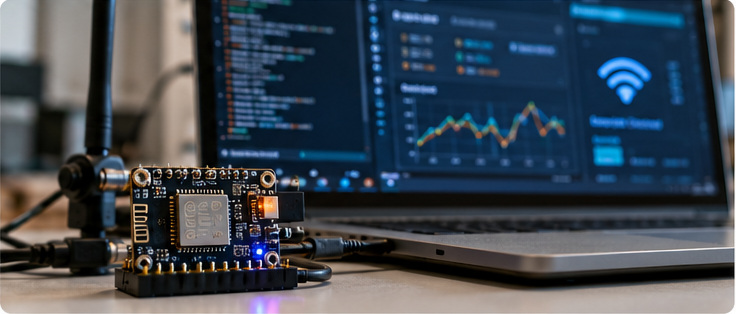
13. LoRaWAN-Based Smart Agriculture Monitoring System
Difficulty: Beginner to Intermediate
Project concept
Smart agriculture benefits from wireless sensors that measure environmental conditions while consuming relatively little energy.
LoRaWAN is designed for low-power, wide-area IoT applications, making it suitable for many monitoring scenarios.
Project objectives
Measure soil moisture and environmental conditions.
Transmit sensor data through a LoRaWAN-compatible network.
Display measurements through a monitoring dashboard.
Implement configurable alert thresholds.
Analyze wireless reliability and battery consumption.
Recommended tools: Microcontroller development boards, suitable sensors, LoRaWAN modules and gateway, and a dashboard platform.
Evaluation metrics: Packet delivery ratio, energy consumption, communication range, and sensor measurement error.
Expected deliverables: A working monitoring prototype with recorded communication measurements.
Research opportunity: Investigate adaptive transmission intervals to reduce energy consumption.
Students should use the regionally permitted frequency plan and comply with local transmission requirements.
14. IoT-Based Flood Early-Warning Communication Network
Difficulty: Intermediate
Project concept
Environmental monitoring requires reliable communication between distributed sensing locations and monitoring stations.
This project develops a prototype capable of detecting simulated or laboratory-scale water-level changes.
Project objectives
Integrate water-level sensors with wireless communication modules.
Send measurements to a monitoring system.
Detect predefined threshold conditions.
Investigate communication reliability during simulated network interruptions.
Develop a local alert interface.
Recommended tools: ESP32, water-level sensors, LoRa or another suitable wireless technology, and Python.
Evaluation metrics: Alert delivery delay, packet delivery ratio, communication availability, and power consumption.
Expected deliverables: Sensor network prototype, alert dashboard, and communication performance analysis.
Research opportunity: Compare conventional single-path communication with a redundant alert-delivery strategy.
Important: A student prototype must not be presented as a validated public-safety flood warning system without extensive field testing and certification.
15. Ultra-Wideband Indoor Positioning System
Difficulty: Intermediate to Advanced
Project concept
Indoor positioning is difficult because satellite navigation signals may be weak or unavailable inside buildings.
Ultra-wideband (UWB) technology can support precise ranging in suitable environments.
Project objectives
Establish a positioning area using reference anchors.
Obtain distance measurements from a mobile tag.
Estimate the tag's location using multilateration.
Investigate the effect of obstacles and multipath propagation.
Recommended tools: UWB development modules, microcontrollers, Python, and MATLAB.
Evaluation metrics: Mean positioning error, median error, 95th-percentile error, and update rate.
Expected deliverables: An indoor localization prototype and a positioning accuracy map.
Research opportunity: Evaluate calibration or filtering methods for improving measurements in non-line-of-sight conditions.
A simulation-only version is possible when UWB hardware is unavailable.
16. Low-Power Wearable Wireless Sensor Communication
Difficulty: Intermediate
Project concept
Wearable devices depend on wireless communication methods that balance data transmission, device size, and energy consumption.
This project focuses on the communication subsystem of a non-diagnostic wearable sensing device.
Project objectives
Acquire data from a motion or environmental sensor.
Transmit measurements using Bluetooth Low Energy or another appropriate wireless technology.
Implement configurable sampling and transmission intervals.
Evaluate battery usage and packet reliability.
Recommended tools: BLE-capable microcontrollers, sensors, Python, and a mobile or desktop interface.
Evaluation metrics: Energy per transmission, battery life under defined operating assumptions, latency, and packet loss.
Expected deliverables: A wearable sensor prototype and power-consumption study.
Research opportunity: Compare periodic transmission with event-triggered communication.
Any physiological measurements should be used only within an appropriate educational and ethical framework, not for unvalidated medical diagnosis.
17. Vehicle-to-Everything Communication for Intersection Safety
Difficulty: Advanced
Project concept
Vehicle-to-Everything (V2X) communication can support the exchange of information between vehicles and surrounding infrastructure.
This project studies communication performance in a simulated traffic intersection.
Project objectives
Model vehicles moving through an intersection.
Generate periodic safety-related messages.
Simulate changing wireless congestion.
Develop a message-prioritization or resource-allocation strategy.
Evaluate the delivery of time-sensitive messages.
Recommended tools: SUMO, ns-3, Python, and compatible simulation interfaces.
Evaluation metrics: Packet delivery ratio, end-to-end latency, channel load, and message age.
Expected deliverables: A traffic-network simulation and comparative communication results.
Research opportunity: Investigate how message scheduling affects communication reliability in congested intersections.
This project should be evaluated as a simulation study, not as proof of real-world vehicle safety.
Category 4: Optical, Satellite, and Next-Generation Connectivity
18. Free-Space Optical Communication Under Atmospheric Conditions
Difficulty: Advanced
Project concept
Free-Space Optical (FSO) communication transmits information using optical beams through the atmosphere.
Its performance can be affected by alignment, atmospheric attenuation, and turbulence.
Project objectives
Model an optical wireless communication link.
Simulate selected atmospheric conditions.
Investigate optical power loss.
Evaluate transmission reliability under different channel conditions.
Recommended tools: MATLAB, Python, or optical communication simulation software.
Evaluation metrics: Received optical power, BER, outage probability, and link availability.
Expected deliverables: An FSO link simulator with comparative results.
Research opportunity: Compare adaptive transmission techniques under varying channel impairment assumptions.
19. Wavelength-Division Multiplexing Optical Network Optimization
Difficulty: Intermediate to Advanced
Project concept
Wavelength-Division Multiplexing (WDM) allows multiple optical signals to use different wavelengths in a fiber-optic communication system.
This project examines the relationship between optical network configuration and performance.
Project objectives
Model multiple optical communication channels.
Investigate wavelength spacing and channel capacity.
Analyze noise and dispersion effects.
Evaluate optical power requirements.
Compare different network configurations.
Recommended tools: OptiSystem, MATLAB, or suitable photonic simulation tools.
Evaluation metrics: BER, optical signal-to-noise ratio, Q-factor, and channel utilization.
Expected deliverables: Optical network model, eye diagrams, and performance report.
Research opportunity: Investigate wavelength allocation or power optimization subject to channel-performance constraints.
20. Hybrid Satellite–Terrestrial Emergency Communication Network

Difficulty: Advanced
Project concept
Communication networks can experience service disruptions during natural disasters or infrastructure failures.
This project investigates whether a simulated hybrid network can maintain connectivity when selected terrestrial links become unavailable.
Project objectives
Design a hybrid terrestrial and satellite communication topology.
Simulate failures affecting terrestrial connectivity.
Implement alternative routing mechanisms.
Evaluate continuity of service during link failures.
Recommended tools: ns-3, Python, and satellite link-budget modeling tools.
Evaluation metrics: Recovery time, packet loss, throughput, latency, and service availability.
Expected deliverables: A fault-tolerant communication simulation and performance comparison.
Research opportunity: Develop a routing policy that considers both path reliability and satellite communication delay.
21. Wi-Fi 7 Multi-Link Operation Performance Analysis
Difficulty: Advanced
Project concept
Wi-Fi 7 is associated with IEEE 802.11be, which introduces enhancements for extremely high throughput and lower-latency wireless networking.
Multi-Link Operation (MLO) is an important area for performance investigation.
Project objectives
Create a model of a wireless network with multiple available links.
Implement a baseline link selection strategy.
Develop an adaptive packet-scheduling algorithm.
Evaluate the effect of congestion and interference on performance.
Recommended tools: A network simulator with suitable MLO functionality, MATLAB, or Python.
Evaluation metrics: Throughput, latency, jitter, and fairness.
Expected deliverables: A scheduling model and comparative performance analysis.
Research opportunity: Study traffic-aware scheduling for applications with different latency requirements.
If a simplified multi-link model is used, identify its assumptions rather than claiming full IEEE 802.11be compliance.
Category 5: AI, Network Security, and Sustainable Communications
22. Radio-Frequency Fingerprinting for Wireless Device Authentication
Difficulty: Advanced
Project concept
Radio-frequency fingerprinting investigates whether differences in transmitted signal characteristics can help distinguish wireless devices.
A student project can analyze labeled, authorized signal recordings or simulated RF impairments.
Project objectives
Generate or collect an approved RF signal dataset.
Extract signal characteristics related to transmitter impairments.
Train a device-classification model.
Evaluate performance across different signal conditions.
Recommended tools: Python, GNU Radio, MATLAB, and scikit-learn.
Evaluation metrics: Classification accuracy, precision, recall, false acceptance rate, and robustness to channel changes.
Expected deliverables: An RF fingerprinting model and validation report.
Research opportunity: Determine whether classification performance remains reliable when test signals come from different environments or recording sessions.
Students should avoid treating RF fingerprints as perfectly unique or inherently secure identifiers.
23. Federated Learning for Wireless Network Anomaly Detection
Difficulty: Advanced / Research-Oriented
Project concept
Federated learning enables distributed participants to train a shared model while keeping their raw training datasets locally.
This project investigates its use for detecting abnormal network traffic.
Project objectives
Prepare a suitable network traffic dataset.
Divide the data among simulated network nodes.
Train a centralized baseline model.
Implement a federated-learning approach.
Compare detection accuracy and communication overhead.
Recommended tools: Python, PyTorch, Flower, and scikit-learn.
Evaluation metrics: F1-score, false-positive rate, training time, and communication cost.
Expected deliverables: A federated-learning experiment and comparative analysis.
Research opportunity: Evaluate the effects of non-identically distributed data across participating nodes.
Important: Federated learning does not automatically guarantee privacy. Model updates may still expose sensitive information unless appropriate protections are applied.
24. UAV-Assisted Wireless Relay Network Optimization
Difficulty: Advanced
Project concept
Unmanned Aerial Vehicles (UAVs) are being studied as potential mobile communication relays in temporary or difficult-to-cover environments.
This project investigates how UAV position affects communication link performance.
Project objectives
Model a terrestrial wireless communication system.
Introduce a simulated UAV relay.
Calculate propagation conditions for different relay locations.
Optimize placement according to a defined communication objective.
Recommended tools: MATLAB or Python with numerical optimization libraries.
Evaluation metrics: Coverage probability, throughput, outage probability, and estimated energy requirements.
Expected deliverables: A UAV communication simulation and relay-placement optimization report.
Research opportunity: Examine trade-offs between coverage improvement, relay height, and assumed energy limits.
Simulation is recommended unless the institution has suitable authorization and controlled facilities for physical UAV experiments.
25. AI-Based Energy Optimization for Mobile Communication Networks
Difficulty: Advanced
Project concept
Wireless communication infrastructure consumes energy even when network traffic varies substantially throughout the day.
This project investigates how adaptive resource management can reduce modeled energy consumption while maintaining acceptable service quality.
Project objectives
Generate realistic or clearly defined synthetic network traffic profiles.
Model base-station or network-resource energy consumption.
Implement a conventional resource-management strategy.
Develop an adaptive optimization algorithm.
Compare energy and service-performance trade-offs.
Recommended tools: Python, MATLAB, scikit-learn, or reinforcement-learning libraries.
Evaluation metrics: Energy consumption, energy per transmitted bit, throughput, latency, and service constraint violations.
Expected deliverables: An energy-management model, performance dashboard, and comparative analysis.
Research opportunity: Develop an algorithm that reduces energy consumption without exceeding specified latency or minimum-throughput constraints.
This is particularly suitable for students interested in sustainable telecommunications and intelligent network automation.
From Project Idea to Engineering Implementation: A Practical Guide for 2026
Choosing a communication engineering graduation project requires more than selecting a trending technology. Students must understand the underlying engineering problem, identify realistic implementation requirements, choose appropriate performance metrics, and evaluate their proposed solutions using reliable experiments or simulations.
In 2026, communication engineering projects increasingly combine wireless communication theory, artificial intelligence, embedded systems, digital signal processing, and network optimization. However, the academic value of a graduation project depends on the technical work performed rather than the popularity of its topic.
The following examples demonstrate how students can transform promising project ideas into meaningful engineering investigations.
1. Developing a 5G Wireless Communication Project
A 5G communication project offers students an opportunity to apply digital modulation, OFDM, channel estimation, error correction, and multiple-antenna communication techniques.
For example, a project titled “Performance Analysis of OFDM-Based 5G Communication Under Different Channel Conditions” could investigate how wireless channel impairments affect data transmission reliability.
Technical Implementation
Students can develop a MATLAB or Python simulation consisting of:
Random binary data generation.
Symbol mapping using QPSK or QAM.
OFDM modulation using an inverse fast Fourier transform (IFFT).
Cyclic prefix insertion.
Transmission through additive white Gaussian noise and multipath fading channels.
Channel estimation and equalization.
OFDM demodulation and bit recovery.
The simulation should vary signal-to-noise ratio (SNR) and channel conditions to measure performance.
Performance Evaluation
Important metrics include:
Bit Error Rate (BER): The fraction of transmitted bits detected incorrectly.
Spectral Efficiency: The useful information rate transmitted per unit of bandwidth, normally expressed in bits/s/Hz.
Error Vector Magnitude (EVM): The difference between ideal and measured or simulated modulation symbols.
Computational Complexity: The processing resources required by the implemented methods.
Students can compare least-squares channel estimation with minimum mean-square error estimation, documenting the performance and computational trade-offs.
Potential Original Contribution
An original contribution might involve improving channel estimation under low-SNR conditions or evaluating algorithm robustness when channel characteristics differ from those used during development.
This creates a clear technical research question that can be investigated through reproducible simulations.
2. Applying Artificial Intelligence to Wireless Communication
Artificial intelligence is increasingly investigated for tasks such as channel estimation, beam selection, interference prediction, and network-resource allocation.
However, integrating a neural network does not automatically improve communication performance.
Students must identify the limitations of conventional techniques and establish whether their AI-based solution delivers a measurable benefit.
Example: Machine Learning for Wireless Channel Estimation
A possible graduation project could examine whether machine learning improves channel estimation in challenging wireless environments.
Step 1: Create a communication model.
Develop a simulated wireless link using an appropriate fading-channel model.
Step 2: Establish conventional baselines.
Implement least-squares and another appropriate established channel estimation algorithm.
Step 3: Generate training data.
Create simulated channel realizations across selected SNR levels and propagation conditions.
Step 4: Train the AI model.
Use Python and PyTorch or TensorFlow to develop a model that predicts channel characteristics from received pilot information.
Step 5: Compare performance.
Evaluate normalized mean-square error, BER after equalization, inference time, and model size.
Step 6: Test generalization.
Evaluate the model using previously unseen channel realizations and conditions rather than relying only on the training data.
Research Value
The project becomes more meaningful when students investigate where AI succeeds, where it fails, and whether the computational overhead is justified.
For example, a neural network might perform well under familiar channel conditions but become less reliable when the propagation environment changes.
Documenting these limitations creates a stronger engineering analysis than simply presenting high prediction accuracy.
3. Building an IoT Communication System With Measurable Results
IoT graduation projects are attractive because they combine communication protocols, sensors, embedded programming, and network monitoring.
Nevertheless, building a dashboard that displays sensor readings is not sufficient to demonstrate communication engineering expertise.
Students should also evaluate the wireless network.
Example: LoRaWAN-Based Smart Agriculture System
A smart agriculture project might involve transmitting environmental measurements from distributed sensor nodes to a gateway.
The system could include:
Microcontroller-based sensor nodes.
Soil moisture and environmental sensors.
LoRaWAN-compatible radio modules.
A suitable network gateway.
Local or cloud-based data storage.
A monitoring dashboard.
Engineering Questions
The project can investigate:
How does increasing the interval between transmissions affect power consumption?
How does the communication environment affect successful packet delivery?
What is the relationship between transmission settings and device battery life?
How reliably does the system deliver measurements under controlled conditions?
Important Evaluation Metrics
Packet Delivery Ratio (PDR):
PDR = Successfully received packets / Transmitted packets
Communication Latency: The time required for a sensor message to reach the receiving application.
Energy Consumption: The energy required for sensing, processing, and wireless transmission.
Network Reliability: The ability to maintain successful data delivery under defined operating conditions.
Potential Original Contribution
Students could design an adaptive data transmission strategy that modifies reporting frequency according to environmental changes or battery conditions.
They would then compare this strategy against a fixed transmission interval using equivalent experimental conditions.
The result would be a communication engineering investigation rather than only an IoT demonstration.
All practical radio experiments should follow local spectrum and transmission regulations.
4. Designing and Evaluating a MIMO Antenna System
Antenna engineering projects allow students to investigate electromagnetic propagation, resonant structures, impedance matching, and array performance.
A project involving a two-element microstrip MIMO antenna is a practical example.
Design Process
Stage 1 — Define the requirements.
Determine the intended operating frequency, substrate material, bandwidth, available space, and design constraints.
Stage 2 — Develop the antenna geometry.
Create the microstrip antenna structure and calculate initial dimensions using suitable antenna design equations.
Stage 3 — Perform electromagnetic simulation.
Use CST Studio Suite, HFSS, or another appropriate electromagnetic simulator.
Stage 4 — Optimize the design.
Investigate antenna dimensions, feeding arrangements, element spacing, and isolation methods.
Stage 5 — Evaluate performance.
Analyze return loss, bandwidth, antenna gain, radiation efficiency, mutual coupling, and envelope correlation.
Stage 6 — Validate experimentally when possible.
Fabricate a prototype and use suitable laboratory instruments, such as a vector network analyzer, to measure impedance matching and coupling.
Research Value
Students could compare two antenna configurations to investigate whether a proposed decoupling structure reduces mutual coupling while maintaining acceptable antenna bandwidth and radiation performance.
A proper evaluation should document potential trade-offs. Improving isolation, for example, does not guarantee that every other antenna performance metric will also improve.
5. Investigating Future 6G Technologies Through Simulation
Although 6G research is developing rapidly, students should distinguish emerging research concepts from deployed communication standards.
The ITU IMT-2030 framework identifies several future connectivity scenarios, including integrated sensing and communication.
A suitable graduation project might investigate a simplified joint communication and sensing system based on OFDM waveforms.
Proposed Investigation
The project can study how waveform parameters influence both communication reliability and the accuracy of sensing-related measurements.
Students would:
Model an OFDM communication signal.
Simulate signal propagation and target reflections.
Implement communication signal detection.
Estimate target distance or motion from reflected signal characteristics.
Compare performance using different waveform settings.
Communication metrics: BER, throughput, and spectral efficiency.
Sensing metrics: Range-estimation error and velocity-estimation error.
Original Research Opportunity
Students can investigate the trade-off between communication resources and sensing resolution.
Such work should be clearly presented as an exploratory simulation, with assumptions and technical limitations stated explicitly.
6. How to Demonstrate an Original Engineering Contribution
A successful project should answer a specific technical question using a reproducible methodology.
Originality may result from:
Introducing an improved optimization technique.
Comparing existing algorithms under new experimental conditions.
Developing a practical hardware implementation.
Evaluating communication performance using a carefully documented dataset.
Investigating energy efficiency, complexity, or reliability trade-offs.
Identifying limitations in an established communication method.
For example, a project comparing conventional and AI-assisted beamforming could investigate the following hypothesis:
An intelligent beam-selection algorithm can reduce beam-search overhead under selected mobility and channel conditions without causing an unacceptable reduction in spectral efficiency.
Students would need to define what constitutes acceptable performance, implement comparable methods, and test the hypothesis.
They should not describe improvements as proven unless the results actually support the claims.
7. Essential Deliverables for a Professional Graduation Project
Regardless of the chosen topic, students should aim to produce the following engineering outputs:
Technical design: System block diagrams, mathematical models, and component specifications.
Working implementation: Executable simulation code, a hardware prototype, or both.
Baseline comparison: Results comparing the proposed approach with a relevant existing method.
Performance evaluation: Clearly labeled graphs, tables, measurement results, and appropriate metrics.
Reproducibility documentation: Software versions, configuration settings, datasets, and experimental assumptions.
Limitations analysis: An explanation of unresolved challenges, operating constraints, and possible sources of error.
Final presentation: A technical demonstration explaining the problem, methodology, engineering contribution, and results.
8. Final Recommendations for Communication Engineering Students
Students choosing a graduation project for 2026 should prioritize technical feasibility, measurable outcomes, and relevance to their academic and professional goals.
Students interested in wireless network engineering may benefit from OFDM, 5G simulation, and intelligent handover projects.
Students interested in artificial intelligence can investigate signal detection, channel estimation, and network optimization.
Those seeking practical hardware experience can explore IoT communication systems, SDR applications, indoor positioning, and antenna design.
Students planning postgraduate research may consider integrated sensing and communication, reconfigurable intelligent surfaces, and intelligent wireless resource management.
Ultimately, the quality of a communication engineering graduation project depends on the depth of its methodology, the validity of its evaluation, and the clarity of its engineering contribution.
A technically focused project with reliable experiments is more valuable than an ambitious project that cannot demonstrate meaningful results.
Comparison: Which Communication Engineering Project Should You Choose?
Not every project requires the same technical background or laboratory resources.
The following comparison helps students identify a suitable starting point.
| Project area | Example project | Difficulty | Main development approach |
|---|---|---|---|
| Digital communications | Adaptive modulation | Beginner–Intermediate | MATLAB/Python simulation |
| IoT | Smart agriculture monitoring | Beginner–Intermediate | Hardware and software |
| Wireless networking | 5G NR simulation | Intermediate–Advanced | Simulation |
| SDR | Spectrum monitoring | Intermediate | RF receiver and software |
| Antenna engineering | Microstrip MIMO antenna | Intermediate–Advanced | Electromagnetic simulation |
| Optical communications | WDM network | Intermediate–Advanced | Optical simulation |
| AI and telecommunications | Intelligent handover | Advanced | ML and network simulation |
| 6G research | Integrated sensing and communication | Advanced | Modeling and simulation |
| Network security | Federated anomaly detection | Advanced | AI development |
| Sustainable networks | AI energy optimization | Advanced | Simulation and optimization |
Difficulty ratings are editorial estimates for a typical undergraduate team. Actual complexity depends on scope, available equipment, prerequisite knowledge, and supervisor requirements.
Best Projects by Student Goal
For beginners: Adaptive modulation, IoT smart agriculture, and receive-only SDR spectrum monitoring.
For students who enjoy MATLAB: OFDM communication simulation, Massive MIMO, antenna modeling, and digital predistortion.
For students who prefer Python: AI beamforming, federated anomaly detection, intelligent network optimization, and energy-management algorithms.
For students seeking hardware experience: LoRaWAN sensor networks, indoor positioning, wearable communications, and microstrip antenna prototyping.
For students considering master's or PhD research: Integrated sensing and communication, Open RAN optimization, intelligent beamforming, and RIS-assisted networks.
MATLAB vs Python: Which Is Better for Communication Engineering Projects?
MATLAB and Python are two widely used choices for engineering simulations and research programming.
The best option depends on the project's requirements rather than a universal ranking.
| Feature | MATLAB | Python |
|---|---|---|
| Communication system modeling | Strong dedicated toolboxes | Extensive scientific libraries |
| Signal processing | Built-in engineering workflows | NumPy, SciPy, and related libraries |
| AI development | Deep learning and ML tools | PyTorch, TensorFlow, scikit-learn |
| 5G modeling | Dedicated 5G Toolbox | Depends on selected libraries and frameworks |
| Licensing | Commercial or academic license | Many free, open-source tools |
| Research reproducibility | Strong with documented toolboxes and code | Strong with documented packages and environments |
| Hardware integration | Supported SDR workflows | GNU Radio and hardware-specific libraries |
For students whose universities already provide MATLAB licenses, MATLAB may offer a more direct starting point for standards-oriented physical-layer modeling.
Python can be especially attractive for machine learning, custom optimization, automation, and open-source development.
A hybrid approach is also possible, provided the team carefully documents data exchange and dependencies.
Useful documentation:
How to Choose the Right Communication Engineering Graduation Project
A strong project begins with a manageable engineering problem.
Students should evaluate potential topics using five main criteria.
1. Technical Relevance
Does the project address a real communication engineering challenge?
Examples include improving wireless reliability, reducing latency, minimizing energy use, or increasing the accuracy of signal detection.
2. Feasibility
Can the proposed system realistically be completed with the team's knowledge and available resources?
Projects that require expensive test equipment, licensed spectrum, complex hardware fabrication, or large datasets may need a narrower scope.
3. Measurable Outcomes
Can the project demonstrate its performance using recognized engineering metrics?
Examples include:
BER versus SNR for a digital communication link.
Throughput and latency for a wireless network.
Return loss and gain for an antenna.
Packet delivery ratio and power consumption for an IoT network.
Detection accuracy and false-positive rate for an AI model.
4. Original Contribution
A project does not need to invent a completely new technology.
It may contribute through improved parameter selection, a reproducible comparison, a useful implementation, or performance analysis under previously unexplored conditions.
5. Research and Career Alignment
Students interested in telecommunications companies may prefer network optimization and wireless system projects.
Students interested in academic research may benefit from advanced physical-layer modeling, AI-assisted communications, and emerging 6G topics.
A Practical Graduation Project Development Roadmap
A structured workflow helps students move from an initial idea to a defensible engineering result.
Phase 1: Define the Engineering Problem
Write a clear problem statement.
For example:
Conventional beam-selection methods can require substantial search overhead in changing wireless channels. This project investigates whether a machine-learning-assisted selection method can reduce that overhead while maintaining acceptable communication performance.
The problem statement should identify the limitation and explain what the team intends to investigate.
Phase 2: Review Existing Research
Examine relevant journal articles, standards, technical reports, and open-source implementations.
Useful research resources include:
Prioritize authoritative sources and recent papers while including established foundational research.
Phase 3: Establish a Baseline
Before introducing a new method, implement a recognized baseline algorithm or system.
For example, compare AI beamforming against conventional codebook beam selection.
A baseline allows the project to demonstrate whether its proposed modification has meaningful benefits.
Phase 4: Develop the Proposed Solution
Create the system model and implement the improvement.
Document:
Engineering assumptions.
Algorithms and model architecture.
Data generation or acquisition.
Software libraries and versions.
Hardware configuration, where relevant.
Phase 5: Perform Controlled Experiments
Change important parameters systematically.
For a wireless link, these might include SNR, bandwidth, mobility, antenna count, or channel estimation accuracy.
For an IoT network, they might include distance, packet size, message interval, or battery operating mode.
Keep all non-tested variables controlled wherever possible.
Phase 6: Evaluate Performance
Report performance using appropriate mathematical and engineering metrics.
For example, bit error rate can be calculated as:
BER = Number of incorrectly received bits / Total number of transmitted bits
Results should include meaningful baselines, clearly labeled figures, and enough experimental detail for another student to reproduce the work.
Where simulations involve randomness, use multiple independent runs and report statistical variation when appropriate.
Phase 7: Prepare the Final Documentation
A professional graduation project report should contain:
Abstract and introduction.
Problem statement and research objectives.
Literature review.
System model and methodology.
Proposed design or algorithm.
Implementation details.
Results and discussion.
Limitations and future work.
Conclusion.
References.
Students should distinguish simulated results, measured laboratory results, and theoretical predictions.
Suggested 12-Week Graduation Project Schedule
| Period | Main activity | Expected outcome |
|---|---|---|
| Weeks 1–2 | Topic selection and literature review | Approved problem statement |
| Weeks 3–4 | System requirements and baseline model | Initial simulation or prototype |
| Weeks 5–6 | Proposed algorithm or hardware development | Working initial implementation |
| Weeks 7–8 | Integration and initial testing | Functional system |
| Weeks 9–10 | Controlled experiments and evaluation | Validated results and figures |
| Week 11 | Report writing and corrections | Complete technical report |
| Week 12 | Final presentation and demonstration | Project defense package |
This schedule is an illustrative planning framework. Complex hardware and advanced research projects may need more time.
How to Turn a Graduation Project Into a Research Paper
Some graduation projects may provide a foundation for an academic research paper.
However, publishing research requires more than presenting an application or reproducing an existing algorithm.
A promising research contribution should address a sufficiently clear technical question and be supported by convincing evidence.
Step 1: Identify a Research Gap
Read recent publications to determine which limitations remain unresolved.
Avoid claiming novelty before completing a relevant literature review.
Step 2: Formulate a Testable Hypothesis
For example:
An adaptive handover policy may reduce unnecessary handovers compared with a fixed-threshold approach under specified mobility conditions.
This can be evaluated using measurable outcomes.
Step 3: Compare Against Existing Methods
An improved algorithm should be evaluated under equivalent conditions using established baseline techniques.
Step 4: Demonstrate Reproducibility
Preserve source code, configuration files, simulation assumptions, random seeds, and experiment parameters.
Step 5: Report Limitations Transparently
Do not hide unfavorable experimental cases.
Discuss computational cost, scalability, implementation challenges, and conditions where the method may not provide an improvement.
Step 6: Select an Appropriate Publication Venue
Evaluate journal scope, peer-review processes, indexing information, publication policies, and any associated fees.
A technically sound graduation project may be publishable, but acceptance cannot be guaranteed.
Common Mistakes to Avoid in Communication Engineering Graduation Projects
Choosing a project that is too broad: A complete 6G system is unrealistic as an undergraduate project. A focused study of one waveform, channel model, or optimization problem is more manageable.
Using AI without a clear reason: Machine learning introduces training requirements, data limitations, and computational costs. It must be justified through comparative results.
Ignoring communication theory: A project should demonstrate understanding of propagation, noise, modulation, coding, bandwidth, or network behavior as relevant.
Presenting only attractive graphs: Every graph should relate to a defined experiment and have labeled axes, units, and an explanation.
Comparing algorithms unfairly: Baseline and proposed methods should use equivalent test conditions.
Failing to document assumptions: A simulation may produce misleading conclusions when important channel effects, hardware limitations, or processing costs are ignored.
Leaving testing until the final week: Early verification helps identify mathematical, software, and hardware problems before they become difficult to correct.
Frequently Asked Questions
1. What are the best communication engineering graduation project ideas for 2026?
Strong project ideas include 5G beamforming, Massive MIMO signal detection, intelligent handover, 6G integrated sensing and communication, IoT sensor networks, SDR monitoring, antenna design, satellite communications, and AI-assisted network optimization. The best choice depends on available skills, resources, and project objectives.
2. Which communication engineering graduation project is easiest for beginners?
Adaptive digital modulation, basic IoT sensor communication, and introductory SDR spectrum analysis are suitable starting points. They allow students to demonstrate core engineering concepts without necessarily requiring advanced mathematical optimization.
3. Can I complete a communication engineering graduation project using MATLAB only?
Yes. Many communication engineering projects can be completed through MATLAB and Simulink simulations, especially those involving modulation, channel modeling, MIMO systems, signal processing, and optimization. The simulation must still be carefully validated.
4. Is Python suitable for telecommunications engineering projects?
Yes. Python supports signal processing, machine learning, numerical simulation, network analysis, and software-defined radio development through various open-source tools and libraries.
5. What are the most promising 6G graduation project topics?
Promising research topics include integrated sensing and communication, AI-assisted radio optimization, non-terrestrial networks, RIS-assisted communications, and energy-efficient wireless systems. In 2026, these should generally be approached as research or simulation studies rather than finished commercial 6G implementations.
6. Do I need hardware for my communication engineering graduation project?
Not necessarily. Simulation-based projects can provide strong technical results if they include a clear problem, appropriate engineering models, reproducible experiments, and comparison against existing methods. Some universities may have separate hardware requirements.
7. Which projects are suitable for IEEE-style research papers?
Projects involving a clearly defined algorithmic improvement, rigorous benchmarking, reproducible experimental results, and a meaningful research gap may support a research paper. Examples include AI-assisted beamforming, intelligent handover, ISAC waveform analysis, and wireless energy optimization.
8. How can I make my graduation project unique?
Identify a specific limitation of an existing approach, propose a justified improvement, test it under controlled conditions, and report both strengths and limitations. Novelty may come from an algorithm, experimental scenario, hardware design, dataset, or validated engineering insight.
9. What software is most useful for communication engineering students?
MATLAB, Simulink, Python, GNU Radio, ns-3, 5G-LENA, CST Studio Suite, HFSS, and OptiSystem are useful for different communication engineering applications. Select tools based on the actual project requirements and available licenses.
10. How long does a communication engineering graduation project take?
A focused project may be planned around a university semester, but the actual time depends on complexity, team size, access to equipment, and required deliverables. Simulation projects can be easier to schedule than hardware-intensive projects, though advanced simulations can also require significant development time.
Original Contribution: A Practical Framework for Selecting and Evaluating Projects
Beyond listing project ideas, this guide proposes a simple project-selection framework that students can apply before committing to a topic.
Score each proposed topic from 1 to 5 across the following dimensions:
| Evaluation criterion | Weight |
|---|---|
| Technical relevance | 20% |
| Feasibility and available resources | 25% |
| Measurable engineering outcomes | 25% |
| Potential for original contribution | 20% |
| Career or research alignment | 10% |
Calculate the weighted score for each candidate project.
This is a proposed educational decision framework, not a scientifically validated project-ranking system. It is intended to support structured discussion with a project supervisor.
After choosing a topic, prepare a one-page experiment plan that specifies:
The research question and hypothesis.
The proposed engineering model.
The baseline algorithm or implementation.
Independent variables and controlled parameters.
Primary and secondary performance metrics.
Required software, hardware, and datasets.
Expected risks and limitations.
For example, students investigating intelligent handover should establish a conventional baseline and test both approaches using the same mobility patterns, traffic conditions, and channel assumptions.
This makes the project easier to evaluate and helps separate a technically meaningful improvement from an attractive but unsupported claim.
Conclusion: Build a Graduation Project That Demonstrates Engineering Excellence
Choosing a communication engineering graduation project in 2026 is an opportunity to explore technologies shaping the future of wireless connectivity, intelligent networks, satellite communications, and connected systems.
Whether a student chooses an introductory digital modulation system, an IoT hardware prototype, or an advanced 6G simulation, the most important factor is the quality of the engineering work.
A successful project combines clear objectives, sound technical methods, well-designed experiments, and transparent performance evaluation.
Students should prioritize projects that they can realistically complete, understand deeply, and defend confidently.
The strongest graduation project is not necessarily the most complicated idea. It is the one that solves a clearly defined problem and demonstrates its results through reliable engineering evidence.
At NextDegree, we encourage engineering students to approach graduation projects as opportunities to strengthen their practical skills, develop research thinking, and prepare for future professional and academic challenges.
Explore the possibilities. Choose your research direction. Build your next degree of engineering excellence.
References used for this article
- MathWorks — Communications Toolbox Documentation
- MathWorks — Orthogonal Frequency Division Multiplexing (OFDM)
- MathWorks — 5G Toolbox Documentation
- MathWorks — Massive MIMO Hybrid Beamforming
- MathWorks — Bit Error Rate Analysis
- GNU Radio — Software-Defined Radio Documentation
- www.gnuradio.org
- Espressif Systems — ESP32 Wi-Fi Documentation
- docs.espressif.com
- www.mathworks.com
- Espressif Systems — ESP32 Bluetooth Low Energy Documentation
- docs.espressif.com
- Espressif Systems — ESP-NOW Documentation
- docs.espressif.com
- LoRa Alliance — LoRaWAN 1.0.4 Specification
Questions related to this guide
1. What are the best communication engineering graduation project ideas for 2026?
The best communication engineering graduation project ideas for 2026 include AI-based 5G network optimization, 6G intelligent reflecting surfaces, IoT-based monitoring systems, software-defined radio (SDR), MIMO beamforming, satellite communications, and AI-powered network security. These projects combine emerging telecommunications technologies with practical engineering applications.
2. What are the easiest communication engineering graduation projects for beginners?
Beginner-friendly communication engineering projects include digital modulation comparison using MATLAB, IoT-based smart home automation, satellite link budget analysis, and basic wireless sensor networks. These projects typically require fewer resources and provide opportunities to learn communication principles through simulations or affordable hardware.
3. Which communication engineering graduation projects can be completed using MATLAB?
MATLAB can be used for OFDM communication systems, digital modulation analysis, MIMO beamforming, adaptive noise cancellation, wireless channel modeling, antenna analysis, and 5G network simulations. It enables students to evaluate signal quality, bit error rate (BER), and system performance.
4. What are the best 5G and 6G graduation project ideas?
Promising 5G and 6G graduation projects include intelligent handover management, AI-based network optimization, massive MIMO beamforming, intelligent reflecting surface simulations, energy-efficient wireless networks, and integrated sensing and communication. Most advanced 6G projects in 2026 are research- or simulation-oriented.
5. Can I complete a communication engineering graduation project without hardware?
Yes. Students can complete communication engineering graduation projects entirely through software simulation. MATLAB, Simulink, Python, GNU Radio, and NS-3 support projects involving digital communication, wireless networks, modulation techniques, channel estimation, and network optimization without requiring physical hardware.
6. What are the best AI-based communication engineering graduation projects?
The best AI-based communication engineering projects include machine learning-based network intrusion detection, wireless signal classification, intelligent 5G resource allocation, network traffic prediction, and automated telecommunications fault detection. These projects combine artificial intelligence with real-world communication engineering challenges.
7. What are some low-cost communication engineering graduation project ideas?
Affordable project ideas include MATLAB-based modulation simulations, Python-based network traffic analysis, IoT environmental monitoring using ESP32, LoRa-based sensor networks, and software-defined radio simulations. Costs depend on the hardware, software licenses, and laboratory equipment already available to students.
8. Which programming language is best for communication engineering graduation projects?
Python and MATLAB are among the most useful choices. Python is well suited for artificial intelligence, network analysis, automation, and data processing, while MATLAB is particularly effective for signal processing and communication system simulation. C and C++ are also useful for embedded systems and performance-sensitive applications.
9. What are the best IoT-based communication engineering projects for 2026?
Popular IoT-based projects include smart agriculture monitoring, LoRa-based environmental sensing, wireless smart home automation, smart traffic management, and remote sensor monitoring. These projects help students develop practical experience in wireless connectivity, embedded systems, communication protocols, and cloud-based data monitoring.
10. How do I choose the best communication engineering graduation project?
Choose a project based on your technical interests, available budget, programming skills, team capabilities, and career goals. A strong project should solve a clearly defined engineering problem, use appropriate tools, and produce measurable results such as improved throughput, lower latency, reduced power consumption, or better signal reliability.
11. What are the most innovative telecommunications graduation projects for 2026?
Innovative telecommunications projects for 2026 include AI-assisted 5G optimization, intelligent reflecting surfaces for future 6G systems, cognitive radio spectrum sensing, machine learning-based modulation recognition, and satellite-terrestrial network integration. These topics reflect active research directions in wireless communication and intelligent networking.
12. How can I make my communication engineering graduation project stand out?
To make your graduation project stand out, identify a specific engineering problem, review relevant research, implement a functional prototype or simulation, and compare your solution against an established baseline. Include measurable performance results, clear technical documentation, and a professional demonstration to highlight your engineering contribution.
Need to apply this methodology to your project?
Share your goal and current stage, and we will suggest the most useful next step.